
What is a bunion deformity?
A bunion is more than just a protuberance or a simple bony outgrowth located at the side of the foot. It constitutes a dislocation of the joint connected to the big toe. While the big toe joint is typically aligned in a straight manner, individuals afflicted with a bunion condition have a misaligned joint. This results in a protrusion at the side of the foot that can cause significant discomfort when wearing high heels, formal shoes, and eventually even comfortable sneakers. Moreover, bunions can potentially trigger arthritis and give rise to ambulatory and stability issues in the future.
What are the treatment choices for bunions?
Nonsurgical approaches for bunions include shoe gear modification, padding, using toe separators or pain relief through medication. However, it’s important to note that these conservative methods alleviate pain but do not resolve the underlying bunion deformity; surgical intervention is the sole solution to correct toe alignment.
Should you have already explored options like wearing roomier footwear, employing padding, or trying various remedies, and if persistent pain continues to hinder your activities, you may meet the criteria for undergoing corrective bunion surgery.
What does bunion correction surgery involve?
Given that the bunion deformity essentially involves a dislocated joint, a mere removal of the bony bump won’t lead to resolution. The approach involves internally repositioning the entire joint to achieve a straight alignment. The surgical procedure includes cutting the bone’s neck, shifting the joint as a unit, and stabilizing the bone using hardware.
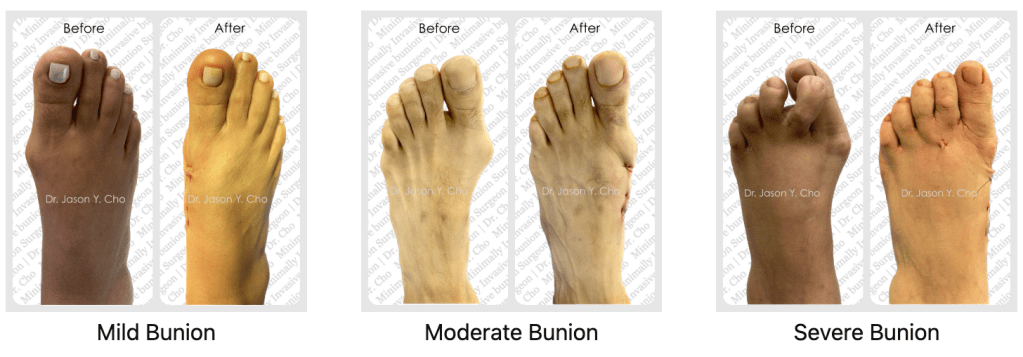
Historically, traditional bunion surgery could be quite painful and entail an extended recovery period due to significant incisions. In contrast, modern minimally invasive method offer considerable advantages. I perform the specialized minimally invasive technique to repair bunions through 3 to 4 tiny portals which leave minimal to no visible scarring. The technique effectively addresses a wide range of bunion deformities, spanning from mild to moderate and even severe bunion cases.
Traditional open bunion surgery vs. minimally invasive bunion surgery.
Traditionally bunion surgery typically involved a large skin incision that extended across the entire big toe joint. This approach resulted in a significant scar and the potential for scar tissue formation within the joint, contributing to joint stiffness. Furthermore, the big incision led to a heightened risk of complications, including infections and structural damage.
Minimally invasive bunion surgery offers less pain, quicker recovery, and better cosmetic outcomes due to smaller incisions. Through the avoidance of extensive incisions, there is a decrease in the disturbance of soft tissues (such as muscle and capsule), resulting in minimized swelling and discomfort following the surgical procedure. This facilitates immediate weight-bearing, less pain, improved aesthetics, and faster return to work and sports.
I’ve observed that patients undergoing the minimally invasive technique require less pain medication, have better range of motion in their big toe, and transition back to regular footwear in half the time compared to those undergoing open surgery.

When is it possible for me to begin walking following bunion surgery?
Owing to the robust and secure anchoring of the screw fixation and employing a specialized bone cut technique, patients can walk immediately following minimally invasive bunion surgery while wearing a designated post-operative shoe. While immediate walking is feasible, it is recommended to minimize weight-bearing and rest during the initial two-week phase to reduce post-surgical swelling. Consistently elevating the operated foot during the initial two weeks can greatly assist in managing postoperative swelling.
What’s the recovery timeline for bunion surgery?
Individuals who have undergone minimally invasive bunion surgery can commence walking using a specialized postoperative shoe as early as the first day. Driving and showering can typically resume by the second to third week. Transitioning to regular sneakers is generally possible around 4 to 6 weeks following the procedure. Engaging in activities like biking or swimming can typically be considered at the 6-week mark, while running and more strenuous activities like jumping may be suitable at around 12 weeks post-surgery.
Do minimally invasive bunion surgeries come with any potential risks?
The majority of patients report high level of satisfaction with their minimally invasive bunion surgery outcomes. Favorable results are achieved if postoperative instructions are followed closely. Risks do exist, including delayed bone healing, although this is uncommon. The risk increases if patients engage in excessive activity too soon against medical advice or have underlying health conditions affecting bone healing. Temporary numbness around incision sites might occur, usually resolving in three to six months, though rare cases of persistence exist. Complications like bleeding, blood clots, and anesthesia-related risks are also infrequent. Bunion recurrence after minimally invasive bunion surgery is exceedingly rare. This can be attributed to the sturdy and secure hardware fixation and specialized bone cut technique employed.
Author
- Dr. Jason (Yong Jun) Cho
 Minimally Invasive Bunion Surgery | Dr. Cho